
Fast or Slow? Accelerated and Deferred Examination in Chinese Patent Examination Procedures by Tina Nan

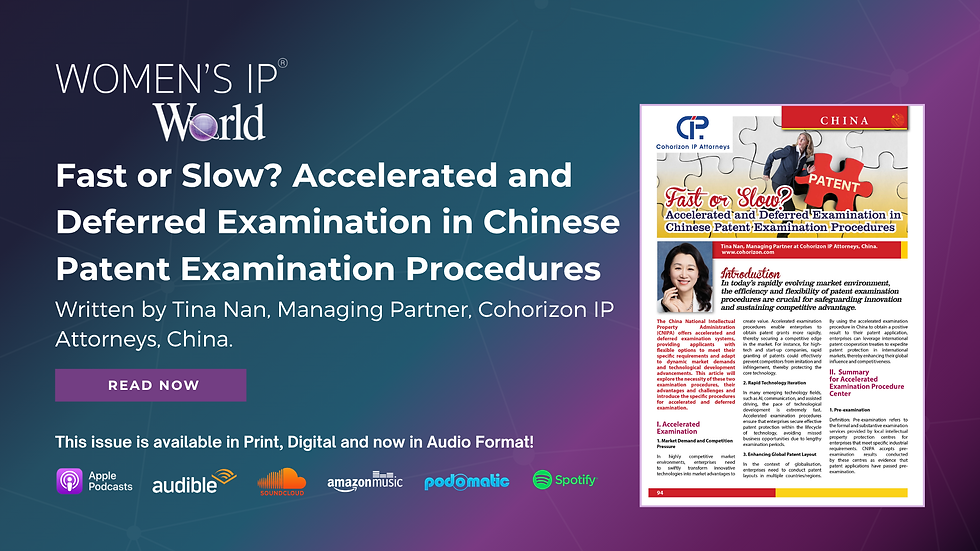
In the Women’s IP World Annual 2025, Tina Nan, Managing Partner at Cohorizon IP Attorneys, China, explores how the China National Intellectual Property Administration (CNIPA) is offering applicants new flexibility through accelerated and deferred patent examination systems. She highlights how these procedures allow innovators to tailor their IP strategies to market demands, competitive pressures, and technological advancements.
The Need for Flexible Patent Systems
In today’s fast-paced innovation ecosystem, the ability to control the pace of patent examination is a competitive advantage. Tina explains how accelerated examination enables rapid patent approval for high-tech sectors like AI, telecommunications, and autonomous driving, protecting cutting-edge ideas before competitors can replicate them. Conversely, deferred examination allows applicants in slower-developing industries, such as pharmaceuticals and materials science, to take a more cautious approach, aligning patent timing with R&D and market readiness.
Accelerated Examination: Staying Ahead of Competition
Accelerated procedures help businesses secure protection when time is critical. Through mechanisms like pre-examination by local IP protection centres, prior examination requests, the Patent Prosecution Highway (PPH), and the “Belt and Road” Accelerated Pilot Project, enterprises can now reduce patent grant times dramatically from several years to as little as three to six months.
These measures have proven invaluable for technology-driven companies and start-ups seeking to strengthen their IP portfolios quickly and enhance global competitiveness.
Deferred Examination: Strategic Timing for Long-Term Gains
Not every innovation needs immediate registration. Tina highlights how deferred examination is ideal for sectors with long R&D cycles or evolving market trends, such as biotechnology, pharmaceuticals, and advanced materials. By delaying examination for up to three years, companies can refine their inventions, protect trade secrets longer, and strategically time their market entry.
Deferred examination also enables applicants to revise claims in light of new developments or align them with emerging industry standards, enhancing the long-term value of their IP.

Balancing Speed and Quality
Tina notes that both fast and slow systems come with advantages and trade-offs. Accelerated examination offers immediate protection but requires preparedness and high-quality documentation. Deferred examination provides flexibility but demands careful planning to avoid missed opportunities.
Ultimately, the ability to choose between the two represents China’s commitment to aligning its IP system with the needs of diverse innovators and industries.
Conclusion
Tina Nan emphasises that flexibility is the future of IP strategy. Whether companies choose to fast-track patents or delay examination, success lies in understanding market timing, aligning with business goals, and leveraging China’s evolving patent frameworks to sustain innovation and global competitiveness.
Read the full article in Women’s IP World Annual 2025, essential reading for innovators, attorneys, and IP professionals seeking to understand how flexibility in patent examination can shape smarter, more strategic protection in China’s dynamic innovation landscape.



Comments